Showing posts with label art. Show all posts

Tuesday, January 12, 2021

illustration or art?

I read somewhere once that the difference between an illustration and art goes something like this: an illustration is something you might glance at for a few seconds in a magazine ad or editorial feature, while art is something you could hang on your wall for twenty years and always admire.

I don't know if that's really true or not, but it's something I remember when looking at artists' work.

I borrowed a coffee table type book from the library on British woman artists because it looked interesting. In all honesty, when reading about the women, I think some of them are more impressive than their works.

One artist was Leonora Carrington, whom I'd never heard of before. She grew up in a Downton Abbey world of privilege between the two world wars. As a young woman, she became a free spirit and an artist and had a love affair with surrealist Max Ernst.

On the eve of World War II, Ernst fled Europe and she had a breakdown, ending up in a mental hospital. When her family sent her to another facility in South Africa, she escaped and fled to Mexico, where she lived for the rest of her long life.

She created many paintings and also sculptures. And, she wrote ten published novels. Her work has been shown many times in exhibitions and some of her artwork is in the collections of some of the world's most famous museums.

With that said, I couldn't help but thinking about the "illustration versus art" comparison mentioned above when looking at her work. It's interesting to examine for a few moments, but would I want to look at it on my wall for twenty years?

Below is her self portrait, painted in the late 1930s (enlargement). It's in the collection of the Metropolitan Museum in New York.


Sunday, December 20, 2020

neckbeard jerkface

A few months back, I posted about a computer whiz who has created realistic digital images of Roman emperors.

In another nod to imperial super-realism, a Spanish artist named Salva Ruano has created amazing sculptures of the more famous — and infamous — emperors. One website described his ultra-realistic Nero as looking like a neckbearded jerkface.

The artist has a website where he shows how he made his sculptures. The text is in Spanish, but if you use a Chrome browser, it should automatically translate for you.

Ruano has also put together four short videos without spoken language showing clips of him making the sculptures. These are posted on his YouTube page. I was particularly impressed with how he stitches in each facial hair by hand, and then cuts them off to recreate stubble. "Creating Nero" is shown below.


Monday, December 7, 2020

the thieves next door

Jerry and Rita were a friendly older couple living outside a small New Mexico town. Little did their neighbors know the two were hiding an incredible secret that wouldn't be known until after both of them died.

Hanging in their bedroom was a Willem de Kooning painting worth $160 million that had been stolen from an art museum decades earlier.

Were Jerry and Rita the thieves who snatched it in broad daylight? Or did they unwittingly buy it from someone who may have known the real secret behind the theft?

Evidence suggest they were the thieves. After Rita died (Jerry had predeceased her), more than a million dollars was discovered in their bank account, a fortune seemingly out of reach for two former teachers.

And there were other hints Jerry and Rita had a secret life. Their twenty-acre property was hardly a cottage, they owned a classic sports car, and they took many long vacations all over the world.

They never sold the painting they may have stolen. So where did the money come from to fund a lifestyle well above their means? That suggests they may have stolen something valuable somewhere else and sold it. If so, what was it? Was it more than one object? No one knows.

(If you're interested in the documentary that's excerpted in the insert window for the linked article, the full 22-minutes video is on YouTube.)


Friday, December 4, 2020

rembrandt farted

A while ago, I clicked a Sotheby's ad on some publication's website, and now I frequently see Sotheby ads at news sites where I can't use an ad blocker. That's to be expected because Google ad services will keep displaying ads from companies you've clicked on in the past.

The face below (enlargement) appeared in a Sotheby's ad this week, so I clicked through to the page and learned that it was a forthcoming lot in an old master print auction. What appears at first glance to be a cartoon is in fact a self-portrait by a young Rembrandt.

What caused that odd expression? Squinting into a mirror while sketching himself? Or clowning around, aping the face of a man who just farted?

He was twenty-six when he did the original but, given the shorter lifespans of his era, not quite as young a man as a twenty-six-year-old today. Given he was an artistic genius, I wouldn't be surprised if he dashed off the original in a few minutes and then made the etching, which would have taken longer.

The expected price is not as high as one might expect for a Rembrandt, but then again it's an etching, not a painting, so more than one identical copy exists. The current bid is £13,000, which is about $17,500 American. The auction estimate for the eventual sale price is £15,000 to £20,000, or about $20,200 to $26,900.

It's not at all big, so maybe that keeps the price down. It only measures about two inches by an inch and three-quarters. If you bought it and wanted to impress a guest when proudly displaying it on your wall, you'd need to also give him or her a magnifying glass.


Saturday, November 28, 2020

mystery monolith

Earlier this month, a helicopter pilot with the Utah Division of Wildlife spotted a mysterious object in the remote desert while counting bighorn sheep.

It's a shimmering, triangular metal monolith ten to twelve feet tall in a box canyon, an area not normally visited by the public (see the photo below and the enlargement). Comparing Google Earth images from 2015 and 2016 shows it appeared somewhere between the two dates. No one has previously reported finding the object.

More imaginative members of the public suggest it was planted by aliens, not unlike the one in 2001. More reality-based folks suspect it is an artist's installation. Who that artist might be, however, remains unknown.

While the alien idea is fun, I vote for the artist culprit. Somewhere, someone hopefully is having a good chuckle at his or her creation finally being discovered.


Friday, October 30, 2020

is david hockney overrated?

I was looking at a magazine offline yesterday that had a picture of a David Hockney painting. That reminded me of how I've always felt that he was somewhat overrated.

You can see an example of his work below (enlargement). It sold last year in New York for more than $2 million American.

Pardon me for sounding like a philistine, but the painting looks like something done by a clever, careful child who was ten or twelve years old. It has the rudeness of something done by someone without training or polished skill.

If it was done by a child, then it shows promise of talent. If it was done by an adult, then it shows a limit of talent.

I guess I expect art to impress me somehow. I can't say that happens with a Hockney painting for me. But at least they're colorful. I could think of worse things to look at on the wall.


Monday, October 19, 2020

the $120,000 banana

Last December, an "artist" duct-taped a ripe banana from the supermarket to the wall and sold the "artwork" for $120,000 American. And then he taped another banana to the wall and sold that for the same price.

And then he did it a third time, but the price was raised to $150,000 American. Two people seriously considered buying it.

The banana obviously would not last, so buyers would be required to restock new bananas regularly as well as duct tape and continually refresh the "art."

Call me a philistine, but that is not art and it does not make him an artist. It makes him a huckster. Had he painted a realistic-looking painting of a banana taped to the wall, then that would be art.

To be considered art, I would argue, requires a talent not found in most people. But nearly anyone who isn't paralyzed, including children of nearly all ages, could tape a banana to a wall.

The real test of this "art," I would argue, is how it will fare in a severe recession. Last December, the American economy was fairly strong. Now, it's mired in a severe recession that only shows signs of worsening. Let's see how much that banana on the wall sells for now.

Better yet, I'll make you a deal. You give me $25,000, I'll fly to your city at my own expense, and I'll duct tape a pineapple to your wall. Fruit flies included for no extra charge. Talk about a bargain.

Saturday, October 17, 2020

fabulous nonsense

I was reading something offline that mentioned the Voynich Manuscript, a highly mysterious book written and illustrated in the early fifteenth century. The text, written in a cryptic script and language, has never been successfully decoded, notwithstanding many experts have tried.

I remember when I first heard about the Voynich Manuscript. My immediate impression at that time, which I still tend to believe, was that it's nothing but gibberish, the product of a highly artistic but troubled mind. Turns out I was not alone in that idea, as some experts who spent a lot of time studying the thing posited the same idea.

The manuscript reminds me of the output from the Chicago-based Henry Darger, a sometime janitor, sometime mental patient, who created, among other things, a surreal illustrated 15,145-page, single-spaced manuscript called In the Realms of the Unreal that was not discovered until after his death in the 1970s. He also created another work that exceeds 10,000 single-spaced illustrated pages plus a "short" work of 4,672 pages.

The Voynich Manuscript today is considered priceless, worth in the tens of millions of dollars. And Darger's work, too, is highly desirable, with a single piece selling for close to a million dollars. His many-volume manuscripts are worth tens of millions, too.

There's something telling about the intersection of big money art and mental illness. Who is the mad one — the artist or the collector? Or both? And what about the people who go to see these in museums?

A partial page from the Voynich Manuscript (enlargement) is seen below.

Sunday, September 13, 2020

artemisia's nail

I read an article offline last week about the early Baroque artist Artemisia Gentileschi who painted from the 1610s through to the 1650s. She is one of the most famous female artists from the pre=modern era.

Some of her paintings are really violent. Two of her most famous works deal with decapitation, before and after, so to speak.

Unlike her other violent paintings, the one seen below (enlargement) catches the moment immediately before the violence takes place. It pictures the female biblical character Jael moments before she drives a nail through the ear of Sisera.

I like how this violent painting depicts an instant of peace just before a burst of extreme violence. When it comes to horrible ways to die, having a big nail hammered into your ear while you're sleeping has to rank right up there.

I was very fortunate to see this painting in person when I was in Budapest about fifteen years ago.

Saturday, August 15, 2020

photorealistic emperors

Trapped at home because of the coronavirus, many people have increased their creative activities. So too has artist Daniel Voshart, who used machine learning and image editing software to create photorealistic portraits of emperors from ancient Rome.

Using 800 images of classical busts and ancient coins as a starting point, Voshart then turned to digital wizardry and software plus his own artistic skills to bring the portraits to life.

Looking through his gallery, many of the faces indeed look real and like people who could be living in the present day. A few look like film and TV stars. And I'm struck by how young some of them are. They look more like skateboard punks than imperial heads of state.

While not part of the images, Voshart does provide some general facts about each emperor. A whole lot of them were murdered by their own guards or troops. Being an emperor was a knife-edge gig. You had a lot of power while in office, but that could all vanish in an instant if you pissed off the wrong people.

Picture below is Voshart's rendering of Augustus. He looks like he could be related to Steve McQueen.

Friday, November 8, 2019

ancient cunnilingus

Recently, I was looking at an art magazine offline with a photograph of a rather erotic ancient statue for sale that might earn an NC-17 rating if it was in a movie. That caused me to think about how early civilizations seemed less squeamish about erotic artwork than people today who implode over a brief glimpse of a partially obscured female nipple at a football halftime show.

While things like saucy woodblock prints wouldn't be widely seen way in past centuries, a bas-relief sculpture on the side of a structure certainly would have been. So why did humans become more uncomfortable about erotic art with time?

I suspect a good part of the answer is the early church. Pre-Christian art had lots of erotica, so church leaders associated paganism and polytheism with artistic smut.

Ergo, erotica is deemed bad because it's anti-Christian and heretical. Out come the swaddling cloths and fig leafs. Naughty bits must be hidden from view.

But we've moved past that. It's time to bury the seventh century paranoia. I'm not saying we should have hardcore public murals, but we also shouldn't have hysteria over the occasional asscrack seen in public art.

Wednesday, July 3, 2019

mona, whatever

A Portuguese digital artist has reimagined major art icons into modern-day settings, and you can see some of the results below with reworkings of Mona Lisa.

Other revamped artists include Frida Kahlo in a pink tanktop, Salvador Dalí as a backpacker, and Vincent Van Gogh on a skateboard. He sells the results as posters. IMHO, he'd probably get a lot of businss with some of these on T-shirts, too.

DeMilked has many more examples, if you find the sampling below intriguing.


Thursday, May 16, 2019

meules

On Tuesday, Claude Monet's painting Meules (which means grainstacks in French) sold at auction in New York for $110 million, the highest public price ever for any impressionist work. The painting last sold in the 1980s for $2.5 million, giving the former owner a fantastic investment return.

IMHO, this is an incredibly beautiful painting. If I was a billionaire, I don't know if I would pay $110 million for it, but that doesn't take anything away from the picture's magic.

The buyer was not disclosed, suggesting it was a private party. Hopefully that person will allow the painting to be displayed publicly for a period of time so that all who see it may enjoy it.

Tuesday, April 23, 2019

creepy cool

This gif is fantastic but sort of creepy at the same time (enlargement). This is the sort of thing that would've scared me silly when I was about five years old for whatever reason.

The animation is by Bill Domonkos, who does all sorts of way out there animated gifs. I bet he has some really interesting dreams.

Friday, April 12, 2019

what about murals?

I've written before about the Confederate monument controversy. My take is to move them but not to hide nor destroy them.

But what about controversial murals? An article currently running in the New York Times magazine reports on a series of murals about George Washington at a high school in San Francisco that has caused heated public debate.

My take on this is that the murals should stay exactly where they are because they could be a powerful lesson about how history is often sanitized and distorted by one group at the expense of others. What better place for these murals then a high school?

They can learn about Washington, how the murals are alternatively accurate and inaccurate, at the same time they can learn about the danger of distorting history. They can also learn about the WPA and the Depression. They could also create their own mural to depict what they believe is a more accurate depiction of Washington's life.

In a phrase: what an opportunity! Ergo, the murals should stay exactly where they are.

Sunday, March 10, 2019

shirtless abe lincoln

This statute is inside the federal courthouse in Los Angeles. It depicts a shirtless young Abe Lincoln posing like a pouty, insouciant Calvin Klein underwear model.

It was actually sculpted in 1939 by a 22-year-old artist named James Lee Hansen who used himself as a model. So he was the one who developed the pouty, insouciant underwear model look several years before Calvin Klein was even born.

Hansen is still alive and celebrated his 101st birthday last year. I wonder if he still looks like a pouty, insouciant underwear model. I suspect not.

Thursday, March 7, 2019

art market insanity

I'm sorry, but this is just loony: a painting by an artificial intelligence computer generates "fine art" paintings, one of which recently sold for $432,500.

Essentially, this is a picture created by fancy software and printed by high-quality laser printers.

I'm not impressed by the results, an example of which can be seen below. It looks like something a color printer would produce when the paper got stuck in the rollers.

Sometimes it seems like portions of the art market suffer from periods of tulip mania. This sale definitely seems like a good example to me.

Friday, February 1, 2019

monet in london

I was reading offline in the newspaper about Claude Monet's London paintings, a few of which I've seen in person at various museums. IMHO they're some of his greatest paintings and add further diversity to his work, making him the greatest of all impressionists.

I saw the painting below (enlargement) at the National Gallery in London on a day that looked like a Monet painting. I had walked along the river earlier in the day and then felt the same mood when looking at his painting. It was an experience I don't think I'll ever forget.

Staring deep into this picture, you can see and feel the sights and sounds and smells of the riverfront. What did people think when they walked by and saw Monet painting these by the river? Did they even know who he was?

I could not find any information about whether one of his London paintings sold recently. Most of them are already in museums so availability would be extraordinarily limited. How much would one of his London scenes fetch? I'd guess tens of millions. His painting of a stack of grain sold for more than $80 million in late 2016.

Friday, December 28, 2018

glass bacteria

I think these are both beautiful and fascinating. They're giant bacteria and virus cells hand-rendered as sculptures in blown glass.

They're designed by a British artist named Luke Jerram, and he calls the collection "Glass Microbiology." If you follow the link above, you can click on each photo, which in turn opens more photos of that particular bacterium or virus.

Most of mankind's most infamous microbes are represented: HIV, malaria, Zika, E coli, Ebola, salmonella, smallpox, and more. Some non-dangerous single-cell friends are also in attendance, including sperm cells.

If you displayed one of the glass microbes on a table in your home, what percentage of your visitors recognize unprompted what they represented? I suspect the number would be very small.

Pictured below is the E coli sculpture being polished by artist Jerram (enlargement).

Monday, December 3, 2018

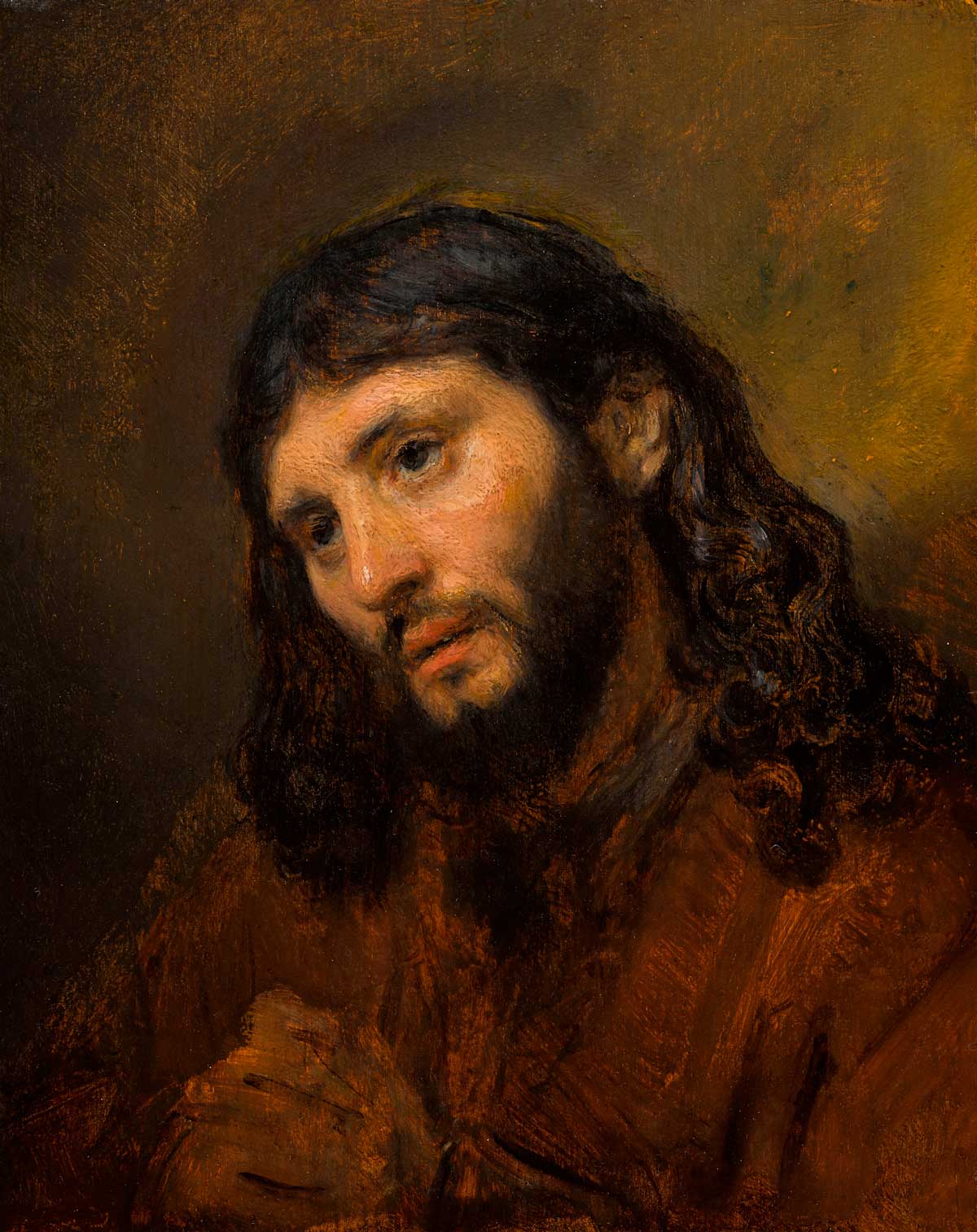
rembrandt’s fingerprints

This Wednesday night in London, Sotheby's auction house will sell a Rembrandt painting that is unique among all of his works -- the artist accidentally left his fingerprints on the wet canvas and they can still be seen today.

The fingerprints' presence is expected to boost both demand and the final price for the painting, which is technically called an "oil sketch." While existence of the fingerprints cannot be used for any scientific purposes, the paintings new owner will have bragging rights to own the only fingerprinted Rembrandt.

The final sale price is expected to be in the range of $8 million US to $10.5 million. So if you've got that bouncing around in your sock drawer, you might want to throw in a bid.